From judgment to practice.
The art of sound judgment, brought to life through practice.
ZUNE PRAXIS
Closed beta- Time
- Recommended: 14 days · Focused: 5 days10–15 min per step
- Outcome
- Your criteria and first action15 judgment and action cards
- Joining
- Invitation-only pilotPaid · fees in your invitation
01 · For whom
When an important choice leaves you unsure what to judge it by
Work, business, education, relationships, and family. When values and real constraints collide, clarify your criteria and the first action you can take.
Business after retirement
“I want to start my own business. How much can I commit?”
Read this example (Korean) ↗Marriage
“What should guide my decision about continuing this relationship?”
Read this example (Korean) ↗Caring for parents
“How can I care for my parents while protecting my own life?”
Read this example (Korean) ↗You do not need every answer now. Choosing what to check and what to do next is itself an important judgment.
02 · Process
Complete your own decision criteria and action plan
Complete 15 judgment and action cards through 14 steps and a practice review. Answer one question at a time to ground each card in your own situation.
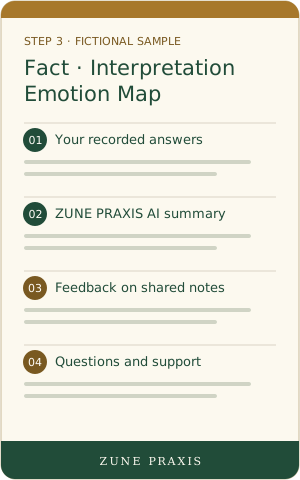
Complete 15 judgment and action cards through 14 steps and a practice review. Answer one question at a time to ground each card in your own situation.
Steps 1–3 Steps 4–7 Establish your criteria
Steps 8–13 Test the choice against reality
Step 14 Commit to a judgment and first action
Explore each stage
Steps 1–3 · Structure the concern
Separate facts, interpretations and emotions, then clarify the decision you need to make.
Steps 4–7 · Establish your criteria
Clarify the outcomes, conditions and priorities that should guide the choice.
Steps 8–13 · Test the choice against reality
Compare options, trade-offs and risks, then design a small experiment.
Step 14 · Commit to a judgment and first action
Record why you chose—or deferred—and define when to reconsider.
JOURNEY TIME
Recommended: 14 days · Focused: 5 days
Allow about 10–15 minutes per step to answer questions about your own situation.
Compare the 14-day and 5-day pace
Focus on one step, then take time to check your thoughts against everyday life before moving on. This pace is intended to keep participation manageable while you revisit earlier answers and build your judgment.
If your decision deadline is close, complete up to three steps a day to finish the main journey in five days. Allow about 30–45 minutes a day.
Both paces cover the same 14 judgment steps. The 14-day and 5-day options refer to the main journey; the practice review takes place seven days after completion. Days off are not treated as delays or failures.
If you need to reach a judgment in less than five days, ZUNE PRAXIS is not the right fit.
AFTER THE JUDGMENT
Practice review seven days after the main journey
Put your first action into practice after the main journey. Seven days later, complete your final card by reviewing what happened and choosing your next action.
YOUR PARTNERS
ZUNE PRAXIS AI
A dialogue partner that helps with questions and organizing your reflections, one question at a time. It does not decide for you.
Human Decision Partner
A person who reviews the content you approve for sharing. You may choose to review that summary with a human Decision Partner to examine your criteria and next actions.
03 · Results
15 judgment and action cards to return to
Keep the records from all 14 steps plus your practice review card. Return to your criteria, reasons, action plan, and review findings when circumstances change.
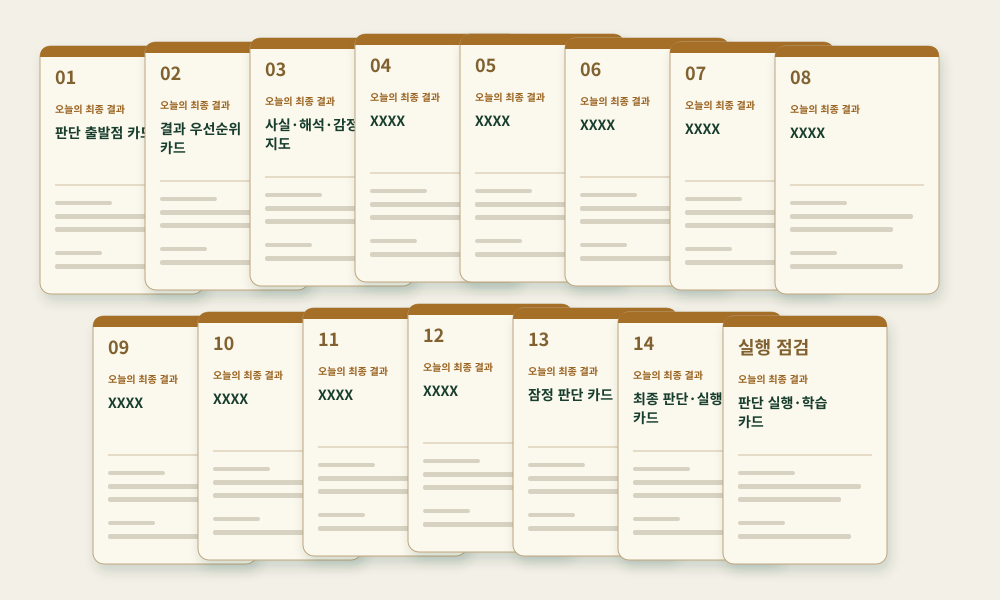
How a card takes shape · fictional sampleClose fictional sample
FICTIONAL SAMPLE · NOT AN ACTUAL PARTICIPANT RECORD
Your answers take shape, with support along the way
Using Step 3, the Fact–Interpretation–Emotion Map, see what goes into a card. Every answer, summary, question, and response below is fictional and created to explain the process.
01
Your recorded answers
Your answers are organized by question
As you answer each step’s questions, your own words are organized into the relevant fields. This step separates what happened, the meaning you gave it, and how you felt.
Illustrative questions and answers
- What happened?
- I was not assigned to two important pieces of work recently.
- How did you interpret it?
- I thought the company no longer needed me.
- How did you feel?
- Hurt, and worried that my role might keep shrinking.
The card keeps your recorded answers under fact, interpretation, and emotion.
02
ZUNE PRAXIS AI’s complementary summary
ZUNE PRAXIS AI adds a complementary summary
It highlights connections in your answers and points that remain unconfirmed. You review the suggestion to check that it reflects what you mean.
Example ZUNE PRAXIS AI summary
Not receiving those two assignments is something you experienced. ‘The company no longer needs me’ is an interpretation that remains unconfirmed. Your anxiety appears connected to uncertainty about your future role.
What to check: the reasons for the assignments and the role expected of you.
The additional summary is grounded in your answers. Your choices and final judgment remain yours.
Sharing and support are optional
03
Feedback on shared reflections
A person responds to what you choose to share
A Human Decision Partner reviews only the content you approve for sharing, helping you examine your criteria and what needs a closer look.
What the participant chose to share
I don’t know why I was left out. I’m worried my role will keep shrinking.
Human Decision Partner’s feedback
Your future role seems to be the main concern. A temporary change in assignments and a lasting reduction in responsibility could lead to different judgments. What information would help you distinguish between them?
04
Questions and support
Ask for help when you get stuck
Beyond feedback on your reflections, you can ask your Decision Partner for help understanding a question or working out a next action.
The participant’s request for help
I’m worried that asking my manager why will sound like a complaint. How could I phrase it?
Human Decision Partner’s response
Could you frame it around your future contribution? Try: ‘What role would you like me to focus on over the next three months?’ Then ask whether the recent assignments are related to that direction.
04 · FAQ
Questions before taking part
How does it differ from fortune telling or expert advice and consulting?
The support you need depends on whether you seek an interpretation of the future, specialist advice, or clarity about your own decision criteria.
| Comparison | Fortune telling | Expert advice & consulting | ZUNE PRAXIS |
|---|---|---|---|
| Main purpose | Interpretations of fortune and the future | Specialist knowledge and possible solutions | Criteria and next actions for your own situation |
| What informs the judgment | A divination system and the practitioner’s interpretation | Professional knowledge, evidence, and analysis | Your reflections, structured questions, and facts checked in real life |
| How it works | Interpretations and advice in response to questions | Problem analysis and proposed alternatives | One question at a time to clarify your thinking and compare options |
| Approach to uncertainty | Consult interpretations of what may lie ahead | Use information and analysis to assess risks and alternatives | Identify what to check and gather evidence through small actions |
| What you take away | Interpretations and advice | Expert opinions and recommendations | Your criteria, reasons for choosing, first action, and conditions for reconsidering |
Main purpose
- Fortune telling
- Interpretations of fortune and the future
- Expert advice & consulting
- Specialist knowledge and possible solutions
- ZUNE PRAXIS
- Criteria and next actions for your own situation
What informs the judgment
- Fortune telling
- A divination system and the practitioner’s interpretation
- Expert advice & consulting
- Professional knowledge, evidence, and analysis
- ZUNE PRAXIS
- Your reflections, structured questions, and facts checked in real life
How it works
- Fortune telling
- Interpretations and advice in response to questions
- Expert advice & consulting
- Problem analysis and proposed alternatives
- ZUNE PRAXIS
- One question at a time to clarify your thinking and compare options
Approach to uncertainty
- Fortune telling
- Consult interpretations of what may lie ahead
- Expert advice & consulting
- Use information and analysis to assess risks and alternatives
- ZUNE PRAXIS
- Identify what to check and gather evidence through small actions
What you take away
- Fortune telling
- Interpretations and advice
- Expert advice & consulting
- Expert opinions and recommendations
- ZUNE PRAXIS
- Your criteria, reasons for choosing, first action, and conditions for reconsidering
Approaches vary by provider. ZUNE PRAXIS supports participants in making their own judgments. It does not replace qualified medical, legal, tax, investment, or other specialist advice.
Do I have to complete exactly one judgment step each day?
The recommended 14-day pace is one step a day; the focused 5-day pace allows up to three steps a day. Both cover the same 14 steps, followed by a practice review seven days after completion. Days off are not treated as delays or failures.
Will ZUNE PRAXIS AI make the decision for me?
ZUNE PRAXIS AI organizes answers and supports questions. Your choices and final judgment remain yours.
Will what I write also be shared with a human Decision Partner?
A human Decision Partner uses the concern you describe in your application to assess whether the program is a suitable fit. During the program, you decide whether to share your records. If you prefer not to share, you can continue with private records only.
Can I join now?
Founding Pilot 01 is currently invitation-only. Use the invitation link you received; participation is confirmed after your application is reviewed and payment is received.
Is this a paid program?
ZUNE PRAXIS is a paid service. Participation fees will be announced after the official launch.